
Our story
The Family Roast wasn't designed. It was revealed.
Every family already plays this game. They just never had cards for it.
You know the rules even if you've never said them out loud. Somebody retells the story everyone has heard forty times. Somebody insists they never behaved the way the entire family clearly remembers them behaving. An old photo surfaces and the room turns on one person like a jury that already knows the verdict. There's teasing, and under the teasing there's history, and under the history there's the strange comfort of being known well enough that someone can call you out — and then pass you the potatoes.
That was already happening at Dan and Valentina's table. The only question was whether you could put it in a box.
Not a mean box. Not a game that runs on humiliation. A game about the specific privilege of being known.
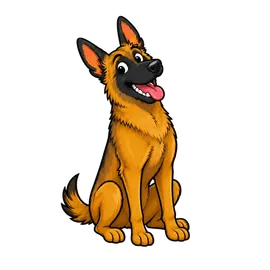
That was December 2024. What followed was 581 days, a mountain of cards that didn't make it, roughly 5,000 that did — and a dog who supervised the entire thing without once being helpful.
The first version tried to do everything.
The earliest Family Roast was enormous, in spirit and in luggage.
It had acting challenges and drawing challenges. Impressions. Singing. Voting. Timed tasks. Would-You-Rather. Spelling. It came with something like 250 game cards, 100 Brownie Points, ten whiteboards, ten markers, and a timer. It was less a card game than a traveling family variety show with a supply list.
Brownie Points were there almost from the start, and they were never leaving. They're the perfect family currency — imaginary, deeply serious, and something people have been earning, losing, and accusing each other of rigging since childhood.
The problem was never a shortage of ideas. The problem was that every idea seemed good enough to keep. So the game got crowded. It was trying to capture every possible way a family could laugh together, and in the process it occasionally made families work overtime to reach the laugh.
But that oversized first draft wasn't wasted. It gave everyone something to argue with. And a lot of people were about to argue.
The families were there from day one.
Here's the part most origin stories get wrong, so let's be clear about it: The Family Roast was never built in a quiet room and then handed to families to approve. Families were playing it constantly, from the very beginning — the rough decks, the ugly prototypes, the versions held together with hope and a paper cutter.
Pamela, David, Jenni, Brian, and numerous parents were early, marking up cards and leaving comments right in the files, flagging the prompts that sounded funny written down but died the second someone said them out loud. That gap turned out to matter more than anything:
A card can be clever without being playable. A challenge can be funny once and unbearable the second time. A rule can make total sense to the person who wrote it and none at all to the family reading it cold.
And every table exposed a different game. Adults caught the ambiguity. Parents caught the age problems. Kids caught boredom instantly and reported it with zero diplomacy. Big groups revealed the pacing drag; small groups revealed which cards secretly needed a crowd. Competitive players found the loopholes. Quiet players revealed where the game asked too much of anyone who didn't want to perform.
None of these families were there to nod politely. They were most useful in the exact moments they didn't react the way anyone hoped.
Thor, for the record, attended most sessions. His contribution was emotional support and occasionally trying to eat a Brownie Point.
The best feedback was the kind nobody said out loud.
The clearest lesson came from watching how long people stayed in.
One six-player family session in late 2025 ran about ninety minutes — and ended before a single person reached the original goal of 10 Brownie Points. Everyone had fun. Nobody finished. That wasn't a failure. That was the game telling on itself: the finish line was too far away.
The same night flagged the rest. Spelling jammed the pace. Small type made cards a squint. House Rules were hilarious right up until they overstayed and quietly hijacked the whole game.
Then there was the test with two adults and a five-year-old. The personal, family cards worked — the kid laughed, answered, belonged. But the moment a round leaned on spelling and reading, the youngest player just... drifted off. Nobody needed a feedback form for that one. A five-year-old wandering away from the table is the most honest review you will ever receive.
The game had to work for the youngest person named on the box. Not claim to. Actually do it.
So it got rebuilt around what families actually loved.
The biggest reactions almost never came from the most complicated mechanics. They came from recognition.
They came when someone got described perfectly and the whole table pointed at the same person before the card was even finished. When a question dragged a twenty-year-old story back into the room. When somebody said "I forgot about that" and, half a second later, "I can't believe you remembered that."
That became the whole game.
Roast cards to lovingly call each other out. Remember cards to pull the family history back into the light. Family Fun for silly moments that don't require anyone to be a trained performer. My Way or the Highway to guess what someone would pick and discover how confidently wrong your family can be. And House Rules for a controlled dose of chaos.
Everything else got cut, shrunk, or transformed. The spelling-heavy material that once ran the show was pulled from the core game. Categories vanished. Names changed. Cards were rewritten, softened, sharpened, or thrown out.
The scoring changed too. The race to 10 became a race to 6. Players now start with one Brownie Point so the game gets moving sooner. House Rules got capped at two turns instead of lingering like a guest who won't leave. Instructions got shorter. The game learned how to start without one of its creators hovering nearby to translate.
This wasn't polish. It was reconstruction — and the blueprint came from real families, not a whiteboard.
The real test: could it survive without its makers?
Eventually Dan and Valentina started handing the game to families they didn't know. Some came through friends, others through Nextdoor and plain neighborhood outreach. Kim, Peggy, Shirley, Jeanette, Charles and their families took copies home and played with their own people, unsupervised.
This mattered more than any in-house test, because founders are terrible instructions. When the creators are at the table, they repair the game without noticing — smoothing a clunky sentence, reminding whose turn it is, ruling on an edge case, nudging things forward before anyone realizes the written rules just failed.
A family playing alone gets none of that rescue. If they misread something, the game eats the consequence. If they stall, nothing talks them back into it. And if they laugh — the game earned it, fair and square.
Not every note got taken; that was never the point. The point was patterns. One person disliking a card is taste. Several unrelated families tripping in the same spot is design. That's the difference the strangers revealed.
Then it had to become a real object.
A game that plays well and a game that can be manufactured are two different animals.
The Family Roast moved through printers, sample-makers, box drafts, card-stock debates, insert designs, and prototypes — files crossing constantly between people who think in jokes and people who think in millimeters. The card count kept shifting as categories changed: 144, then 150, 154, and finally landing where it belongs — 144 game cards and 56 Brownie Points, 200 cards in all.
Everything physical became a problem to solve. The rules had to fit the box and stay readable. The logo had to sit centered on a narrow side panel. The deck had to nest right in the tray. The stock had to feel substantial without blowing up the cost. The box had to survive a truck. Carton counts had to match pallets. Colors that looked perfect on a screen had to actually print that way.
The first production commitment was scoped at 2,502 units — carton math, not ambition. As confidence grew, the run expanded to roughly 5,000 games. Manufacturing landed in Vietnam, chosen partly because shifting tariffs had made China a moving target, which introduced a brand-new vocabulary: freight quotes, deposits, proofs, carton markings, customs, pallet dimensions, cargo-ready dates.
Even after "print-ready" files shipped, the corrections kept coming — an undersized rule sheet here, an off-center logo there. Each fix was tiny on its own. Together they were the whole difference between having an idea and being responsible for what a stranger unwraps on their kitchen table.
Thor, the supervisor.
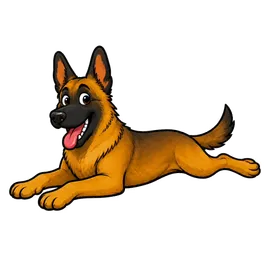
Thor — Dan and Valentina's Belgian Malinois — started as the dog watching the work and slowly promoted himself to mascot, rule guide, comic relief, and Chief Supervising Officer of a company that never asked for one.
The whole visual world grew around him: overhead table scenes, oversized celebrations, sneaky trips to the fridge, cartoon evil laughs, Brownie Point victory dances, and Thor reacting to all of it with the expression of a creature who has seen this family's nonsense before.
Those images got revised as stubbornly as the rules. The table couldn't change size between scenes. The background had to be actually white. The dog had to read as a Belgian Malinois — not a generic shepherd — with the right proportions and the right face. A single speech balloon got a wider body, a white interior, a transparent edge, a thicker border, and its little tail nudged into exactly the right spot.
Fussy? Absolutely. But those details taught the game how to talk before anyone opened the box. The art is what tells you the roasting is play, not war. The colors make it warm instead of harsh. Thor is what gives the rules a personality. And the family scenes make the whole thing feel already lived-in — like the kind of people who'd actually play it are just off-camera, arguing about whose turn it is.
581 days later.
Somewhere in there it stopped being a prototype and became a company. Bravo Games LLC. The Family Roast filed as a trademark in February 2026, published by the USPTO on June 30, with Amazon Brand Registry following in the first days of July. On July 1, the factory sent photos and videos of the finished games, packed and ready. Legal identity, commercial identity, and 5,000 physical boxes all arrived at roughly the same moment.
By July 19, 2026 — 581 days after the first scribbled note about the name — the finished box holds 200 cards.
But that number hides all the cards that didn't make it. It hides the 10-point version that ran too long. The spelling rounds that lost the five-year-old. The rules that needed their creators in the room. The art that was almost-right, the logo that sat slightly off-center, the type that was a hair too small, the dog who didn't quite look like Thor yet, and the speech balloon whose tail once pointed the wrong way.
Most of all, it hides every family who sat down to play a rough, unfinished thing and — without meaning to — showed us what it was supposed to become.
They didn't test a finished product. They revealed it.
What The Family Roast is actually about.
The name makes it sound like it's about insults. It isn't.
A good family roast only works because people know each other. The joke lands because there's history behind it. Everyone remembers the incident. Everyone recognizes the habit. Everyone knows exactly who the card is describing before a name is ever said.
The roasting gets everyone laughing. The remembering is what makes it matter.
That's the whole thing, and it ended up handwritten on the note tucked into every box:
"We made this game for people who love their family and love giving them a hard time — usually at the same time."
It began as a game about calling people out.
It became a game about reminding people they're known.
Thor still doesn't get it. But he supervised every step, and honestly, he earned a Brownie Point or two.